
Progressing Cavity Pumps for Sludge Handling: A Technical Approach to Reducing Lifecycle Cost in Wastewater Treatment
- Jul 1
- 6 min read
Water utilities are operating under increasing pressure to improve process reliability, reduce maintenance intervention and extend asset life, while controlling both capital expenditure and operational expenditure.
Within wastewater treatment, sludge pumping remains one of the most challenging areas of the process. The media is variable, abrasive, often high in solids and frequently handled under continuous or semi-continuous duty conditions. For this reason, pump selection should not be based solely on initial purchase price, but on the total cost of ownership across the full operating life of the asset.
Progressing cavity pumps remain a widely used technology for sludge transfer and wastewater applications because of their ability to deliver controlled, positive displacement flow across difficult media. The global progressing cavity pump market was valued at USD 3,225.86 million in 2022 and was projected to reach USD 4,782.84 million by 2030, with a forecast CAGR of 5.0% over 2023–2030, according to Final Report_Global Progressive Cavity Pump Market. The same report lists environment as one of the industry segments for progressing cavity pump applications and includes Sydex among the companies covered in the market analysis. [Final Repo...ump Market | PDF]
For water utilities, this continued market growth reflects a wider operational requirement: reliable pumping solutions capable of handling increasingly demanding sludge and wastewater duties while supporting lower lifecycle cost.
The Technical Challenge of Sludge Pumping
Sludge pumping duties are rarely uniform. A single wastewater treatment works may include multiple sludge streams with different solids content, viscosity, temperature, abrasiveness and process requirements.
Typical applications include:
Waste activated sludge
Thickened sludge
Digested sludge
Raw sewage
DAF waste streams
Sludge transfer to dewatering systems
Industrial wastewater streams
In a recent enquiry the specified duty for a wastewater discharged from DAF application included a flow capacity of 20 m³/hr, 15 m discharge head, 5% solids content, 380 VAC / 3-phase / 50 Hz power supply and two pump sets, showing the type of duty-point detail normally required for technical pump selection.
This type of data is essential because pump performance, rotor/stator selection, installed power, speed, material compatibility and seal arrangement all depend on the actual operating conditions. For sludge applications, correct selection should consider not only rated flow and pressure, but also viscosity variation, solids concentration, run hours, suction conditions, dry-running risk, start-up torque and maintenance access.
Why Whole-Life Cost Matters More Than Purchase Price
The lowest-cost pump at procurement stage is not necessarily the lowest-cost asset in operation.
For water utilities, the real cost of a pumping asset includes:
Initial capital cost
Installation cost
Energy consumption
Routine maintenance labour
Wear part replacement
Unplanned downtime
Spares availability
Site access requirements
Process disruption during maintenance
Asset life
Mechanical equipment specifications for wastewater environments commonly require clear technical documentation, including general arrangement drawings, equipment sectional drawings, parts lists, performance curves and equipment data sheets.
This reinforces a key point for utilities: technical transparency matters. A pump supplier should be able to support the selection with the correct drawings, performance data, materials information, operating instructions and maintenance documentation.
The Sydex Approach to Technical Pump Selection
At Sydex UK, the focus is on providing progressing cavity pump solutions that are correctly selected for the application, rather than simply offering a standard unit.
Sydex has previously described its capability as a manufacturer of progressing cavity pumps and has supplied information for sludge transfer applications, including stainless steel construction as a standard option where required. In a recent enquiry Sydex UK confirmed that stainless steel would not be a problem and was a standard option in response to a sludge transfer enquiry for a wastewater treatment plant project.
This is important for water utilities because material selection can have a direct impact on corrosion resistance, wear life and suitability for the installed environment. Coastal wastewater sites, chemically aggressive sludge streams and applications involving biohazard material may require enhanced material specifications compared with standard cast iron construction.
A technical pump selection should typically assess:
Pump capacity and differential pressure
Solids content and particle characteristics
Viscosity range
Temperature
pH and chemical compatibility
Suction conditions and NPSH considerations
Seal arrangement
Rotor and stator material options
Drive speed and installed power
Baseplate and pipework interface
Maintenance access
Required documentation and test certification
Maintenance-in-Place: Designing for Maintainability
For wastewater operators, maintainability is often as important as hydraulic performance.
Traditional progressing cavity pump maintenance can require significant dismantling, pipework disturbance, lifting equipment and extended isolation periods. In sludge applications, this can increase both direct maintenance cost and indirect process cost.
This is why the Sydex Maintenance-in-Place design option should be positioned as a technical lifecycle benefit rather than simply a convenience feature.
The objective of a Maintenance-in-Place design is to allow access to key wear components, including the rotor and stator assembly, while minimising disturbance to the installed pump and surrounding pipework. This supports faster planned maintenance, reduced site intervention and improved asset availability.
From an asset management perspective, the benefits include:
Reduced maintenance duration
Reduced requirement to disturb pipework
Lower labour input for wear component replacement
Reduced lifting and handling requirements
Improved access for maintenance teams
Lower planned downtime
Improved maintainability in restricted-access installations
Better control of whole-life cost
This is particularly relevant for utilities operating critical sludge transfer or dewatering feed systems where process interruption can quickly affect downstream treatment performance.
Rather than viewing maintenance as an afterthought, Sydex designs can be specified with service access in mind from the outset. For asset managers and specification engineers, this makes Maintenance-in-Place a measurable value proposition: fewer maintenance hours, less disruption and improved operational availability.
Technical Documentation and Compliance Expectations
Water utility projects increasingly require a high level of technical submission detail.
In another project the tender correspondence requested a detailed technical datasheet covering all parameters and duty points, spare parts including stators, rotors and overhaul kits, operating, commissioning and maintenance instructions, drawings, spare parts lists and factory test information. The same correspondence also referenced delivery requirements and standard performance testing.
This demonstrates the level of technical evidence often expected on utility or municipal wastewater projects. It is not enough for a pump to be commercially attractive; it must also be supportable through documentation, testing, spares planning and maintenance information.
For water utilities, key technical submission items may include:
Pump data sheet
Performance curve
General arrangement drawing
Sectional drawing
Materials of construction
Seal details
Rotor and stator specification
Motor and gearbox data
Baseplate details
Spare parts list
Operation and maintenance manual
Test certificates where required
Commissioning guidance
A supplier that can support these requirements helps reduce technical risk during procurement, installation and commissioning.
Competitive Cost Without Compromising Technical Integrity
Budget control remains a major issue for water utilities, but cost reduction must not come at the expense of asset reliability.
The technical objective should be to identify a pump solution that meets the process duty, provides suitable materials of construction, supports maintenance planning and offers strong lifecycle value.
Sydex provides a practical alternative for utilities seeking a balance between engineering quality, competitive pricing and responsive supply. Previous correspondence has referred to standard delivery times of 5–6 weeks for a PC pump enquiry, although actual delivery will always depend on the project specification, factory loading and configuration required.
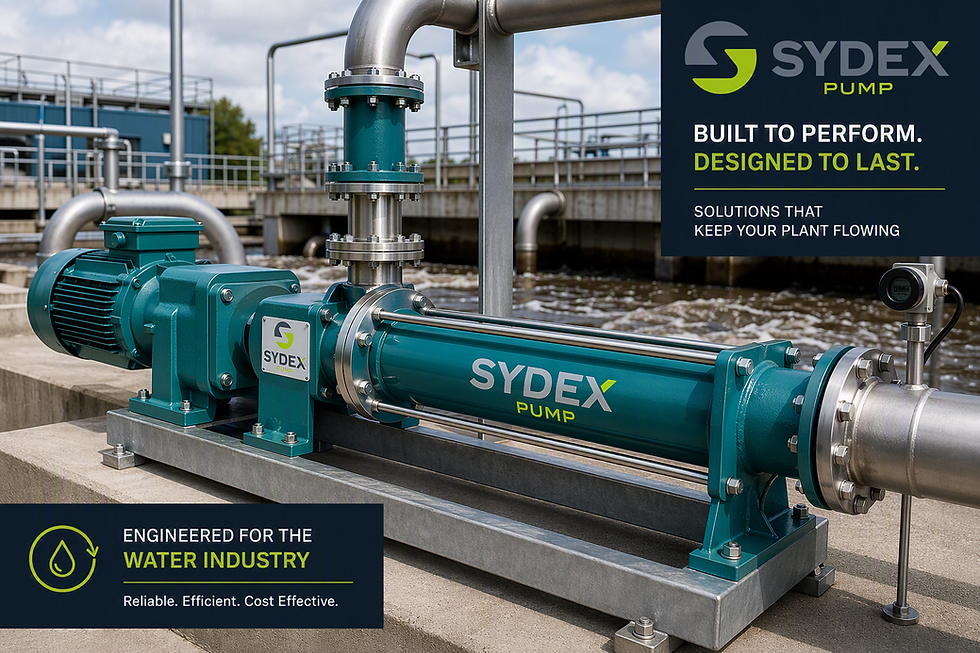
For planned upgrades, framework projects and replacement installations, this responsiveness can help reduce programme risk and support continuity of operation.
A Data-Led Procurement Approach
For water utilities reviewing sludge pump assets, a structured technical evaluation should compare more than brand name and purchase price.
A more robust assessment should include:
Evaluation Area | Why It Matters |
Duty point accuracy | Ensures correct hydraulic and mechanical selection |
Solids and viscosity data | Determines rotor/stator configuration and operating speed |
Materials of construction | Impacts corrosion resistance and asset life |
Seal arrangement | Affects reliability and maintenance frequency |
Maintenance access | Drives labour cost and downtime |
Spares availability | Reduces operational risk |
Documentation quality | Supports compliance, installation and future maintenance |
Lead time | Reduces project and replacement risk |
Whole-life cost | Provides a more realistic cost comparison |
This type of evaluation allows asset managers to compare pumping solutions on operational value rather than initial cost alone.
Conclusion: Engineering Reliability Into Sludge Pumping
Sludge pumping is one of the most demanding areas of wastewater treatment, and pump selection should be treated as a technical lifecycle decision.
For water utilities, the best solution is one that combines:
Correct hydraulic selection
Suitable materials of construction
Reliable handling of high-solids sludge
Practical maintenance access
Strong technical documentation
Competitive acquisition cost
Responsive delivery
Lower whole-life ownership cost
Sydex progressing cavity pumps are designed to support these requirements, offering utilities a technically credible and commercially attractive alternative for sludge and wastewater pumping applications.
With Maintenance-in-Place design options available across many pump configurations, Sydex can help utilities reduce maintenance disruption, improve asset availability and control lifecycle cost.
Reliable operation starts with correct selection. Lower lifecycle cost starts with maintainable design.
For water utilities reviewing sludge transfer assets, upgrading treatment infrastructure or seeking alternatives to traditional premium-priced suppliers, Sydex offers a practical, technically robust solution.


Comments